
N-Butanol: Uses, Benefits and Industrial Applications
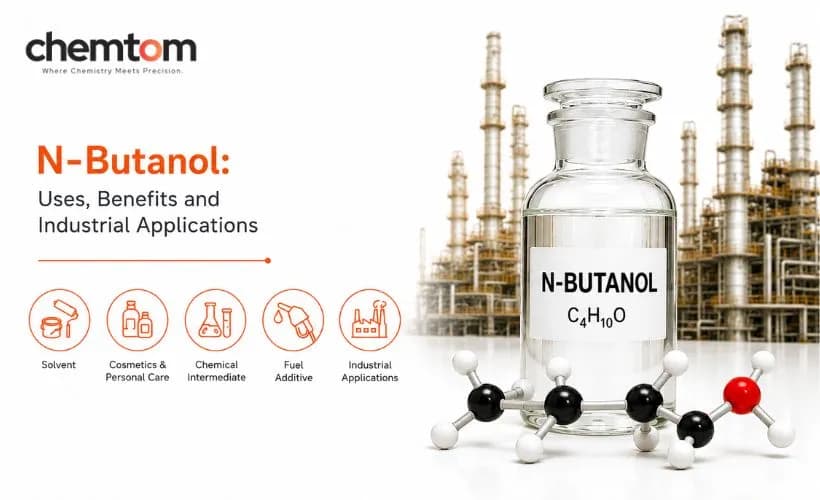
N-Butanol, also known as n-butyl alcohol, is a four-carbon alcohol widely used as a solvent, chemical intermediate, and formulation ingredient across industrial sectors. It is identified by CAS No. 71-36-3 and is valued for its solvent properties, compatibility with numerous organic materials, and role in producing derivatives such as butyl esters.
As a fragrance chemicals product, N-Butanol can also be relevant to fragrance manufacturing and aroma-related formulations, particularly where it is used as a processing solvent or as a chemical intermediate for producing fragrance ingredients.
For manufacturers, formulators, procurement teams, and industrial buyers, understanding n-butanol uses, quality requirements, handling considerations, and sourcing factors is important for selecting the appropriate grade and supplier.
This guide explains what N-Butanol is, its key properties, n-butanol benefits, major n-butanol applications, and important factors to consider when sourcing it for industrial and fragrance-related requirements.
What Is N-Butanol?
N-Butanol is a primary four-carbon alcohol with the chemical formula C₄H₁₀O. It is also called n-butyl alcohol and is identified by CAS number 71-36-3.
It is a colorless liquid with a characteristic alcoholic odor and is used extensively as an industrial solvent and chemical intermediate.
N-Butanol belongs to the family of butyl alcohol isomers. The "n-" designation indicates the normal or straight-chain structure, distinguishing it from branched butanol isomers.
Key characteristics of N-Butanol
Important characteristics relevant to industrial use include:
Chemical name: N-Butanol / n-Butyl Alcohol
CAS number: 71-36-3
Molecular formula: C₄H₁₀O
Molecular weight: approximately 74.12 g/mol
Appearance: Colorless liquid
Chemical class: Primary alcohol
Industrial role: Solvent and chemical intermediate
Its combination of solvency, volatility, and compatibility with organic materials makes it useful across multiple formulation and manufacturing processes.
Key Features and Benefits of N-Butanol
1. Effective Solvent Properties
One of the most important n-butanol benefits is its ability to dissolve or assist in processing various organic compounds, resins, coatings, and formulation ingredients.
This makes it useful in coatings, inks, adhesives, and chemical manufacturing.
2. Useful Chemical Intermediate
N-Butanol is also used as a starting material or intermediate for producing various derivatives, including butyl esters.
These derivatives can have applications in coatings, plasticizers, solvents, and specialty chemical formulations.
3. Versatile Industrial Material
The versatility of N-Butanol allows manufacturers to use it in different processes rather than restricting it to one specific industry.
Its applications extend into:
Coatings
Paints
Printing inks
Adhesives
Chemical manufacturing
Plasticizers
Fragrance-related manufacturing
Specialty formulations
4. Relevance to Fragrance Manufacturing
As a fragrance chemicals product, N-Butanol can be relevant to fragrance and aroma chemical manufacturing processes.
It may function as a processing solvent or intermediate depending on the formulation and manufacturing route. Its suitability depends on the specific product, process, concentration, and required specifications.
5. Formulation Flexibility
N-Butanol can be incorporated into formulations where its solvent characteristics are compatible with the other raw materials and the intended end-use requirements.
How Does N-Butanol Work in Industrial Formulations?
N-Butanol primarily contributes through its solvent and chemical-intermediate properties.
When used as a solvent, it can help dissolve or disperse selected organic materials and improve the processing characteristics of certain formulations.
When used as an intermediate, it participates in chemical reactions to produce downstream materials.
For example, N-Butanol can be used in the production of butyl esters. Depending on the specific ester, these derivatives may be used in coatings, inks, plasticizers, solvents, and specialty chemical applications.
In fragrance-related manufacturing, the exact role of N-Butanol depends on the production process and formulation requirements.
N-Butanol Uses in Different Industries
1. Coatings and Paints
One of the major n-butanol uses is in coatings and paint formulations.
It can function as a solvent or co-solvent and assist with the processing of resins and other formulation components.
N-Butanol may be relevant to:
Industrial coatings
Architectural coatings
Protective coatings
Paint formulations
Resin-based systems
Formulators select solvents according to factors such as evaporation behavior, resin compatibility, viscosity, and final coating performance.
2. Printing Inks
N-Butanol is also used in certain printing ink systems.
Its solvent characteristics can support the dissolution and processing of selected ink components. Depending on the ink technology, it may be incorporated as part of a solvent system.
The final formulation needs to be evaluated for:
Solvent compatibility
Drying behavior
Resin compatibility
Viscosity
Printing performance
3. Adhesives
Certain adhesive formulations can use N-Butanol as a solvent or processing component.
Its role depends on the adhesive chemistry and the other raw materials used.
Manufacturers may evaluate N-Butanol based on its compatibility with resins, additives, and other solvents.
4. Chemical Manufacturing
N-Butanol serves as a chemical intermediate in the production of various downstream chemicals.
A notable example is its use in producing butyl esters, which are important in several industrial formulations.
This makes N-Butanol valuable not only as a finished formulation ingredient but also as a raw material within chemical manufacturing processes.
5. Plasticizers and Related Chemicals
Certain N-Butanol derivatives are used in the manufacture of plasticizers and related specialty chemicals.
Through esterification and other chemical processes, N-Butanol can contribute to the production of materials with different physical and formulation characteristics.
6. Fragrance and Aroma Chemical Manufacturing
Because Chemtom supplies fragrance chemicals, N-Butanol can also be considered within the broader aroma chemical supply chain.
Its role may include use as a solvent or chemical intermediate in processes associated with fragrance ingredient manufacturing.
It is important to distinguish between an aroma-active fragrance ingredient and a material used during fragrance chemical production. N-Butanol's relevance can be process-specific rather than simply being responsible for the final odor profile.
For fragrance manufacturers, the appropriate grade and specification should therefore be confirmed according to the intended use.
N-Butanol Applications in Fragrance Manufacturing
The fragrance industry uses a broad portfolio of solvents, intermediates, natural materials, and synthetic aroma chemicals.
Within this ecosystem, n-butanol applications may include:
Processing and formulation support
N-Butanol may be considered where its solvent properties are compatible with the production process.
Chemical intermediate
It can serve as a feedstock for producing certain butyl derivatives that may have downstream applications in chemical and fragrance-related manufacturing.
Specialty chemical production
Manufacturers may use N-Butanol in chemical processes where its straight-chain alcohol structure is required.
For fragrance manufacturers, selection should always be based on the exact production process and technical specification rather than assuming that every N-Butanol grade is suitable for every application.
Choosing a Reliable N-Butanol Supplier
When selecting an N-butanol supplier, industrial buyers should consider both product and service capabilities.
Look for a supplier that can provide:
Consistent product quality
Clear technical specifications
Batch documentation
Appropriate packaging
Reliable supply
Technical assistance
Transparent communication
Support for recurring requirements
For fragrance and aroma chemical manufacturers, it is particularly important to communicate the intended application so the supplier can provide the relevant product information and documentation.
N-Butanol Supply for Industrial and Fragrance Chemical Requirements
Chemtom supplies chemical products for industrial customers, including materials relevant to the fragrance chemicals sector.
For N-Butanol requirements, customers can discuss their application, quantity, specification, packaging, and documentation needs with Chemtom.
The sourcing approach focuses on:
Product quality: Attention to defined specifications and batch consistency.
Industry expertise: Understanding chemical procurement requirements.
Technical support: Providing relevant product information and documentation.
Reliable supply: Supporting regular industrial purchasing requirements.
Application-focused service: Understanding the intended use before supply.
Customer-focused communication: Clear coordination throughout the procurement process.
For commercial requirements, buyers should confirm the required specification and intended application before final product approval.
Conclusion
N-Butanol, also known as n-butyl alcohol, is a versatile industrial chemical identified by CAS 71-36-3. Its solvent characteristics and role as a chemical intermediate make it useful across coatings, paints, printing inks, adhesives, chemical manufacturing, plasticizer production, and other industrial applications.
As a fragrance chemicals product, N-Butanol can also have relevance to fragrance and aroma chemical manufacturing, particularly as a processing solvent or intermediate depending on the specific manufacturing route.
The key n-butanol benefits include formulation flexibility, useful solvency, and suitability as a raw material for producing downstream chemical derivatives.
For procurement teams, choosing the right N-butanol supplier should involve checking product identity, purity, grade, documentation, packaging, safety requirements, and supply reliability.
Looking for N-Butanol for Industrial or Fragrance Chemical Requirements?
Need N-Butanol (CAS 71-36-3) for your manufacturing or fragrance chemical requirements? Connect with Chemtom to discuss product specifications, documentation, quantity, packaging, and supply requirements.
Contact Chemtom today for your N-Butanol sourcing requirements.