
How Geosmin Influences Food, Water, and Fragrance Industries
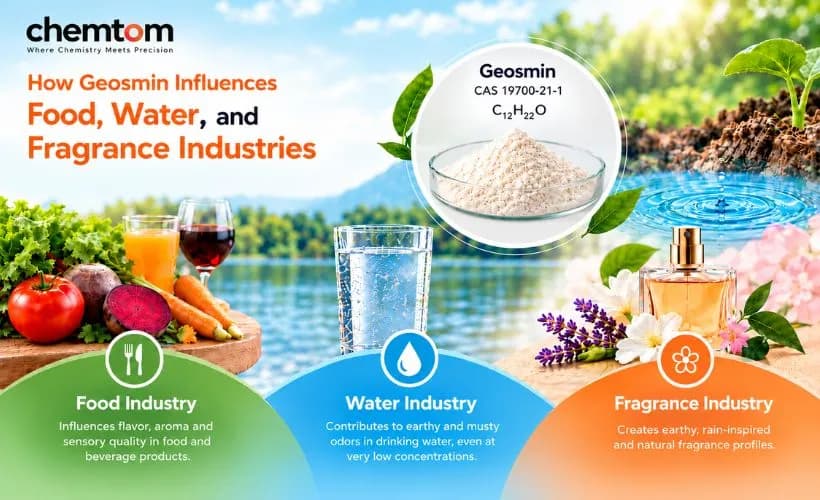
Geosmin is a naturally occurring organic compound best known for its distinctive earthy and musty odor, often associated with the smell of wet soil after rainfall. Although it can be present at extremely low concentrations, its strong odor characteristics make it important across several industries. From influencing the sensory quality of food and drinking water to helping perfumers recreate the smell of rain-soaked earth, Geosmin has a unique role in modern chemical and sensory applications.
Chemically identified as C₁₂H₂₂O, Geosmin has a molecular weight of approximately 182.30 g/mol. It is also identified by CAS 19700-21-1 and is associated with earthy, damp, musty, and soil-like sensory characteristics.
Its influence is particularly noticeable in the food industry, water treatment, aquaculture, flavor applications, and fragrance development. Understanding where Geosmin comes from and how it behaves helps businesses manage unwanted odors while also enabling fragrance professionals to reproduce specific natural sensory impressions.
Geosmin in Food Industry
The role of Geosmin in food industry applications is closely connected with sensory quality. Geosmin may occur naturally in certain fruits, vegetables, aquatic products, and other food-related materials. It is particularly associated with earthy or musty sensory characteristics.
Vegetables such as beetroot can contain naturally occurring Geosmin, contributing to their characteristic earthy aroma. Research has also identified Geosmin as a source of earthy or musty off-flavors in products such as fruits, vegetables, juices, and wine.
Managing unwanted earthy notes
For food manufacturers, Geosmin can become an important quality consideration when an earthy or musty note is not part of the intended sensory profile. Even when a product is otherwise acceptable, an unexpected odor can influence consumer perception.
This is particularly relevant for:
Fruit and vegetable processing
Juices and beverages
Wine and fermented products
Aquaculture products
Food flavor development
Sensory quality control
In aquaculture, Geosmin is particularly important because fish raised in affected water can accumulate the compound, resulting in an earthy or musty off-flavor. Research has documented Geosmin as one of the key compounds associated with off-flavor problems in cultured fish.
For food businesses, monitoring raw materials, processing conditions, water quality, and sensory characteristics can therefore help identify and manage Geosmin-related quality issues.
Geosmin in Water
One of the most recognized environmental roles of Geosmin is its effect on drinking water. Geosmin in water is primarily discussed in connection with taste-and-odor events associated with natural microbial activity.
Certain cyanobacteria and actinomycetes can produce Geosmin. When these organisms become abundant in surface-water sources, Geosmin can contribute to the earthy or musty odor that consumers may notice in treated drinking water. The U.S. Environmental Protection Agency identifies Geosmin and related compounds as contributors to taste and odor problems in water supplies.
Why is Geosmin a concern for water suppliers?
The challenge is primarily sensory rather than simply chemical. Geosmin can be detectable at very low concentrations, meaning that water can meet many conventional quality requirements while still developing an unpleasant earthy smell or taste.
This can lead to:
Consumer complaints
Increased monitoring requirements
Additional treatment considerations
Reduced confidence in water quality
Operational challenges for water utilities
Importantly, the presence of an earthy or musty odor does not automatically mean that cyanotoxins are present. The EPA notes that some cyanobacteria can produce both taste-and-odor compounds and cyanotoxins, but the two should not automatically be assumed to occur together.
Detection and removal considerations
Analytical monitoring can help water professionals identify Geosmin and determine the scale of a taste-and-odor problem. Gas chromatography-based methods are among the analytical approaches discussed in the scientific literature.
Treatment strategies depend on the source water, concentration, treatment plant configuration, and other water-quality conditions. Research has investigated methods including adsorption and other treatment approaches because Geosmin can be challenging to remove from water.
Geosmin in Fragrance Industry
The role of Geosmin in fragrance industry applications is very different from its role in water and food quality.
In perfumery, the earthy smell that people associate with rain falling on dry soil is an evocative sensory experience. Geosmin can contribute a distinctive wet-earth, damp-soil, or petrichor-like character to fragrance compositions.
Perfumers use chemistry to reproduce natural smells that cannot always be captured directly from their natural sources. The Perfume Society describes Geosmin as one of the materials used to recreate the recognizable smell of rain on earth, and synthetic Geosmin is commonly encountered in fragrance contexts.
Creating an earthy fragrance profile
In a fragrance formulation, Geosmin can be used in very small quantities because of its powerful odor character. Depending on the formulation and concentration, it can contribute an earthy, green, damp, or natural dimension.
It may be considered when developing fragrance concepts inspired by:
Rain and wet soil
Forest environments
Natural landscapes
Earthy botanical themes
Aquatic and atmospheric fragrances
Petrichor-inspired compositions
FEMA's flavor library identifies Geosmin under FEMA No. 4682, while industry references describe its odor profile as intensely earthy-musty, with green and herbal nuances in dilution.
For formulators, the key consideration is dosage. A highly odor-active material can quickly dominate a composition if it is not carefully balanced with other fragrance ingredients.
Why CAS 19700-21-1 Matters
CAS 19700-21-1 is an important identifier for Geosmin and helps suppliers, laboratories, formulators, procurement teams, and regulatory professionals distinguish the substance from similarly named materials.
Geosmin is listed by PubChem with the molecular formula C₁₂H₂₂O and molecular weight of approximately 182.30 g/mol. The CAS identifier 19700-21-1 is also recorded by the U.S. FDA's Substance Registration System.
When sourcing Geosmin, buyers should verify the CAS number, specification, concentration or grade, documentation, intended application, packaging requirements, and applicable regulatory requirements.
Geosmin: One Molecule, Different Industrial Impacts
The importance of Geosmin depends strongly on the industry.
For food manufacturers, it can be an unwanted source of earthy or musty off-flavor and therefore a quality-control consideration.
For water suppliers, it is primarily a taste-and-odor challenge that can affect consumer acceptance even at very low concentrations.
For fragrance professionals, the same powerful earthy character can become a useful formulation tool for creating natural, atmospheric, rain-inspired, or soil-like accords.
This contrast makes Geosmin particularly interesting from a chemical and sensory perspective. A characteristic that may be undesirable in drinking water or certain foods can be intentionally incorporated into a fragrance formulation when an earthy environmental impression is required.
Sourcing Geosmin for Industrial Requirements
For businesses purchasing Geosmin, selecting a dependable chemical supplier is important for maintaining consistency across laboratory, formulation, research, and industrial applications.
Before placing an order, buyers should evaluate:
Correct chemical identity and CAS 19700-21-1
Required purity or concentration
Product specification
Certificate of Analysis (COA)
Safety Data Sheet (SDS)
Packaging requirements
Quantity and MOQ
Delivery requirements
Export documentation, where applicable
Chemtom supports customers looking for industrial and specialty chemical sourcing solutions, including products used across different technical and formulation applications. As a supplier and exporter, Chemtom can help buyers discuss product requirements, documentation, packaging, and supply needs according to their application.
Conclusion
Geosmin demonstrates how one highly odor-active compound can have very different significance across industries. Geosmin in food industry applications is closely linked with earthy off-flavors and sensory quality, while Geosmin in water is an important contributor to taste-and-odor challenges in water supplies. In contrast, Geosmin in fragrance industry applications can provide formulators with a distinctive earthy and rain-soaked character.
With its identifier CAS 19700-21-1, Geosmin is a specialized chemical that requires careful handling, accurate identification, and application-specific sourcing. Understanding its sensory behavior and industrial relevance can help manufacturers, formulators, laboratories, and procurement teams make more informed decisions when evaluating this compound.
Get in Touch with Chemtom
Looking for Geosmin (CAS 19700-21-1) for your industrial, formulation, research, flavor, or fragrance requirements? Contact Chemtom to discuss your required specification, quantity, packaging, documentation, and export requirements.