
Industrial Uses of 1-Nonanol in Aroma Chemicals
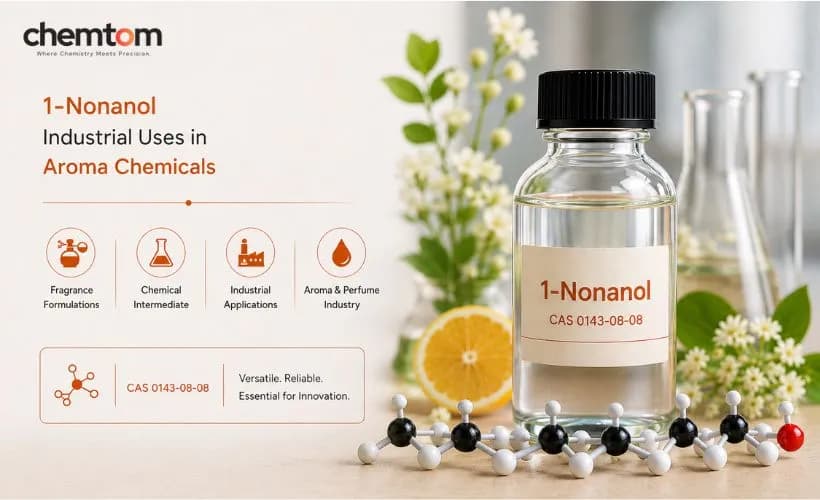
1-Nonanol is a long-chain fatty alcohol used in several industrial and specialty chemical applications. Also known as nonan-1-ol, it is valued for its characteristic odor, chemical stability, and ability to serve as an intermediate in the production of fragrance ingredients and other specialty chemicals.
In the aroma chemicals industry, 1-Nonanol is particularly relevant because of its odor profile and its role in developing fragrance compositions. Manufacturers and formulators can use it directly in selected applications or as a starting material for producing other compounds used in perfumes, fragrances, flavors, and related formulations.
Understanding the 1-Nonanol uses and its industrial role helps fragrance manufacturers, aroma chemical buyers, formulators, and procurement teams select suitable raw materials for their applications.
This article explores the major 1-Nonanol industrial uses, with a focus on its importance in aroma chemicals and fragrance-related applications.
1-Nonanol in the Aroma Chemicals Industry
The aroma chemicals industry relies on a wide range of organic compounds to create distinctive fragrance profiles. These materials may be used directly in formulations or converted into other fragrance ingredients through chemical reactions.
1-Nonanol has relevance in this sector because of its odor characteristics and functional hydroxyl group. The alcohol group provides a reactive site that can participate in processes such as esterification, allowing manufacturers to produce derivatives with different olfactory and functional properties.
Its use therefore extends beyond simply adding an odor note. Depending on the formulation and manufacturing process, 1-Nonanol can contribute to the development of fragrance materials with specific sensory characteristics.
Key 1-Nonanol Uses in Aroma Chemicals
1. Fragrance Formulations
One of the important 1-Nonanol uses is in fragrance compositions where its characteristic odor can contribute to the overall scent profile.
Fragrance formulators combine individual aroma chemicals to achieve specific sensory effects. 1-Nonanol may be incorporated into selected formulations where its odor characteristics complement other fragrance ingredients.
Its performance depends on factors such as concentration, formulation composition, product type, and the interaction between different aroma materials.
2. Intermediate for Fragrance Ingredients
1-Nonanol can also function as a chemical intermediate for producing derivatives used in specialty fragrance applications.
The hydroxyl group of 1-Nonanol allows it to participate in chemical reactions such as esterification. These reactions can generate compounds with different odor profiles and formulation characteristics.
This makes 1-Nonanol useful to manufacturers looking for versatile starting materials for aroma chemical production.
3. Development of Fruity and Waxy Odor Profiles
Long-chain aliphatic alcohols can provide distinctive odor characteristics that are useful in fragrance development.
1-Nonanol is associated with an odor profile that can be described as fatty, waxy, and citrus-like under appropriate conditions. In fragrance formulation, such characteristics may be used to add depth or support particular odor accords.
Professional perfumers typically use 1-Nonanol alongside other aroma chemicals rather than relying on it as a standalone fragrance material.
4. Production of 1-Nonanol Derivatives
Another significant area among the 1-Nonanol industrial uses is the production of derivatives.
The chemical structure of 1-Nonanol makes it suitable for further chemical transformation. Depending on the manufacturing process, it can be converted into derivatives with applications across fragrance, flavor, and specialty chemical industries.
This versatility makes it a useful raw material for chemical manufacturers developing customized or application-specific ingredients.
5. Fragrance and Perfume Manufacturing
The fragrance and perfume industry requires consistent-quality aroma chemicals to maintain product performance from batch to batch.
1-Nonanol can be used as part of the raw material portfolio for perfume and fragrance manufacturing. Its inclusion depends on the desired fragrance profile and the technical requirements of the final formulation.
For manufacturers, sourcing consistent-quality 1-Nonanol is important because variations in purity or specifications can affect formulation performance.
Other Industrial Uses of 1-Nonanol
Although aroma chemicals are an important area, the 1-Nonanol industrial uses extend into other specialty chemical applications.
Chemical Intermediate
1-Nonanol can serve as an intermediate in the synthesis of other organic compounds. Its terminal hydroxyl group provides useful chemical functionality for further reactions.
Specialty Chemical Manufacturing
Manufacturers may use 1-Nonanol as a raw material in processes requiring a long-chain primary alcohol. Its chemical properties make it relevant to selected specialty chemical manufacturing applications.
Solvent and Formulation Applications
Depending on the formulation and process requirements, long-chain alcohols can have utility in solvent-related and formulation applications. The suitability of 1-Nonanol depends on the specific technical specifications and intended end use.
Why Is 1-Nonanol Important for Fragrance Manufacturers?
Several characteristics make 1-Nonanol relevant to aroma chemical manufacturers and fragrance formulators.
1. Distinctive odor characteristics
Its odor profile can contribute specific sensory characteristics to fragrance compositions.
2. Chemical versatility
The hydroxyl group allows 1-Nonanol to participate in chemical reactions and derivative production.
3. Application flexibility
It can be relevant to both direct fragrance formulation and intermediate production.
4. Specialty chemical value
Its use is not limited to a single industry, making it a versatile raw material for specialty chemical applications.
5. Consistency requirements
Reliable purity and consistent specifications are important for manufacturers using 1-Nonanol in commercial formulations and chemical processes.
How to Choose a Reliable 1-Nonanol Supplier
Selecting the right supplier is an important step for manufacturers purchasing 1-Nonanol for industrial applications. Buyers should evaluate suppliers based on several factors:
Product Quality
Check the supplier's technical specifications, purity information, and quality-control procedures. Consistent product quality is particularly important for aroma chemical manufacturing.
Technical Documentation
A reliable supplier should be able to provide relevant technical and safety documentation, including product specifications and safety information where applicable.
Supply Consistency
Industrial buyers should consider whether the supplier can provide consistent material availability and support regular procurement requirements.
Packaging and Handling
The packaging should be appropriate for the product's characteristics, transportation requirements, storage conditions, and intended industrial use.
Export and Logistics Support
For international buyers, experience in export documentation, packaging, shipping coordination, and regulatory requirements can make procurement more efficient.
Why Choose Chemtom for Aroma Chemicals?
Chemtom supports customers looking for reliable aroma chemicals and specialty fragrance ingredients for industrial applications.
When sourcing materials such as 1-Nonanol, buyers should focus on product consistency, technical specifications, documentation, supply reliability, and responsive customer support.
Chemtom works with customers to understand their application requirements and provide suitable aroma chemical solutions for fragrance and related industrial applications.
If you are evaluating 1-Nonanol for fragrance manufacturing, aroma chemical production, or another industrial application, connect with Chemtom to discuss your requirements.
Conclusion
1-Nonanol is a versatile long-chain alcohol with applications across aroma chemicals and specialty chemical manufacturing. Its characteristic odor and reactive hydroxyl group make it relevant to fragrance formulations as well as the production of selected fragrance derivatives and other chemical intermediates.
The major 1-Nonanol uses include fragrance formulation, aroma chemical manufacturing, chemical intermediate production, and specialty chemical applications. For manufacturers, choosing a dependable source is important to maintain consistent product quality and production performance.
As demand for specialized fragrance ingredients continues to grow, high-quality raw materials such as 1-Nonanol remain valuable to fragrance manufacturers and aroma chemical producers.
For reliable sourcing and application-related requirements, contact Chemtom to discuss your 1-Nonanol requirements.